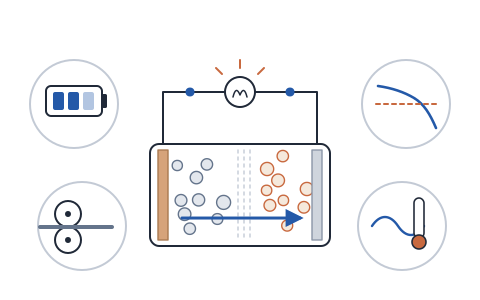
Learning objectives
By the end of this lesson you will be able to:
- say what a rechargeable battery does, and tell a cell from a module and a pack;
- read the six headline numbers on a cell datasheet and say which lesson explains each;
- name the main lithium-ion chemistries and cell formats;
- find your way around the course: lessons, labs, quizzes, progress and the final exam.
Before you start: nothing at all. This lesson is the starting point.
01Energy you can carry
A battery stores energy in chemical form and gives it back as electricity, on demand, wherever it is. Some batteries are used once and thrown away. A rechargeable battery runs its chemistry backwards when it is charged, so the same materials can store and release energy hundreds to thousands of times. Lithium-ion is the rechargeable battery of our time because it stores a lot of energy for its weight and lasts for many cycles.
| Application | Typical energy |
|---|---|
| Smartphone | about 10–25 Wh |
| Laptop | about 50–100 Wh |
| Electric bicycle | about 0.4–0.75 kWh |
| Home storage battery | about 5–15 kWh |
| Electric car | about 40–100 kWh |
| Electric city bus | about 300–600 kWh |
A watt-hour (Wh) is the energy of one watt for one hour; 1 kWh is 1,000 Wh. The range spans more than four orders of magnitude, but the cells inside work the same way. That is what this course is about.
02Cell, module, pack
- A cell is one electrochemical unit: two electrodes, a separator and electrolyte in a sealed case. Its voltage is set by its chemistry, a few volts at most.
- A module is a group of cells connected and held together mechanically, often with sensing wires and cooling.
- A pack is the complete battery a product uses: modules or cells, connected in series to raise the voltage and in parallel to raise the capacity, plus the enclosure, cooling, wiring, fuses and the battery management system.
The battery management system, or BMS, is the pack’s electronics. It measures the voltage of every cell, or of every group of cells wired in parallel, plus the current and the temperature at several points. It estimates how full the pack is, keeps the cells balanced, and switches the pack off before any cell is charged or discharged too far, or gets too hot or too cold. A cell cannot keep itself inside these limits: at most it has a one-shot safety device, such as a vent or a current-interrupt device that disconnects it for good. A phone usually has a single cell and a tiny BMS; an electric car can have thousands of cells.
03Six numbers on a cell datasheet
Every cell comes with a datasheet. Six of its numbers come up again and again, and each one has a lesson in this course:
| Number | What it says | Learn it in |
|---|---|---|
| Nominal capacity (Ah) | How much charge the cell delivers under stated test conditions | Lesson 2 |
| Nominal voltage (V) | A representative average voltage over a discharge | Lesson 1 |
| Energy (Wh) | Capacity times nominal voltage | Lesson 2 |
| Maximum current (A, or a C-rate) | How hard the cell may be charged and discharged | Lesson 2 |
| Cycle life | How many cycles until the capacity falls to a stated level, usually 80 % | Lesson 4 |
| Temperature range | Where the cell may be charged, discharged and stored | Lesson 4 |
Mass and dimensions complete the picture: divide the energy by them and you get the energy per kilogram and per litre that cells are usually compared by.
04Lithium-ion is a family, not one thing
All lithium-ion cells shuttle lithium ions between two host materials, but the materials vary, and they change the voltage, the energy, the lifetime, the safety and the cost. The positive electrode is what usually gives a cell its name:
- NMC and NCA — layered oxides of nickel with manganese or aluminium and cobalt. High energy; common in electric cars.
- LFP — lithium iron phosphate. Lower voltage and energy, but long life, good thermal stability and no nickel or cobalt; common in buses, stationary storage and many cars.
- LCO — lithium cobalt oxide, the original commercial material, still used in many phones and laptops.
The negative electrode is graphite in most cells, sometimes with silicon added for more capacity. And the same chemistry can be packaged three ways: as a cylindrical, a prismatic or a pouch cell. Lesson 3 shows how the format changes the factory.
05How this course works
- Read the lesson. Each one opens with its learning objectives and states its assumptions and limits.
- Use the lab. Most lessons include an interactive workbench, tutorial, simulator or panels. Change things and watch what follows.
- Check yourself. Work out each check-yourself question before opening its answer.
- Take the practice quiz. Multiple-choice and numeric questions are marked in your browser; written ones you compare with a model answer.
- Mark the lesson complete. Your progress shows on the syllabus. It is saved in this browser only, with no account.
- Pass the final exam. When the core lessons are done, the final exam checks the whole course and gives you a printable statement of completion.
Along the way, the glossary defines every term in plain language and the cheat sheet puts the formulas and key numbers on one page. If you like code, the calculations in Lessons 2 and 4 and in Fick’s law also exist as tested Python functions, with notebooks you can run.
06Check yourself
Work each one out before opening the answer.
A phone battery is labelled 5,000 mAh and an e-bike battery 14 Ah. Which stores more energy?
You cannot tell from ampere-hours alone: energy also depends on voltage. The phone’s single cell runs at about 3.85 V, so it holds about 5 × 3.85 ≈ 19 Wh. A typical e-bike pack runs at about 36 V, so 14 Ah is about 500 Wh — some 25 times more. Lesson 2 has the details.
What does a battery management system do that a cell cannot do for itself?
It measures and protects. A cell cannot keep itself from being overcharged, over-discharged or overheated — at most it has a one-shot safety device that disconnects it for good. The BMS watches the voltage of every cell (or parallel group of cells), the temperatures and the current, and disconnects the pack before a limit is crossed. It also balances the cells and estimates the state of charge.
Why does a datasheet state cycle life “to 80 %”?
Because a cell does not suddenly die; it slowly holds less. By convention it is called worn out when its capacity has fallen to 80 % of the rated value, so cycle life is the number of cycles until that point, under stated test conditions.
07Practice quiz
Four quick questions, marked in your browser.
08References and further reading
These sources go deeper. The explanation here is written independently.
- T. B. Reddy (ed.), Linden’s Handbook of Batteries, 4th ed., McGraw-Hill, 2011.
- G. L. Plett, Battery Management Systems, Volume II: Equivalent-Circuit Methods, Artech House, 2015, chapter 1.
- IATA, Lithium Batteries: Passenger Guidance (watt-hour limits for batteries carried by passengers).